
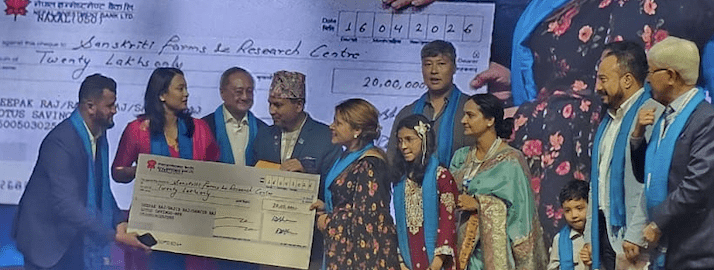
Sanskriti Farms Honored with Prestigious Gopal Kamala Rajbhandari Rotary Award in WASH
Kavrepalanchok, Nepal — Sanskriti Farms & Research Center (SFRC) has been awarded the prestigious Gopal Kamala Rajbhandari Rotary Award in WASH, recognizing its outstanding contributions to rainwater harvesting and Water, Sanitation, and Hygiene (WASH) initiatives in Nepal.
The award was presented during the Rotary International District 3292 – 18th District Conference (April 16–18, 2026), under the auspices of Rotary International. Regarded as one of the most distinguished Rotary recognitions in Nepal, the award carries a cash prize of NPR 2 million ($13,300) and honors impactful, community-driven efforts in advancing sustainable water and sanitation solutions.
Based in Kavrepalanchok, SFRC has been at the forefront of promoting climate-resilient development through innovative and integrated approaches. Its work spans rainwater harvesting, wastewater reuse, and the application of the Food–Energy–Water (FEW) nexus framework. These initiatives have significantly improved water accessibility, strengthened hygiene practices, and supported sustainable agriculture across local communities.
Through strong collaboration with local governments, farming communities, and international partners, SFRC has implemented practical, field-based solutions addressing critical environmental and public health challenges. Its model emphasizes sustainability, local engagement, and knowledge transfer, positioning it as a leading example of community-driven rural development in Nepal.
On receiving the award, SFRC representatives expressed sincere gratitude to their partners, stakeholders, and the communities they serve. They noted that this recognition serves as a strong motivation to further expand their initiatives and continue delivering innovative, scalable solutions.
This achievement underscores the growing importance of integrated water resource management approaches in Nepal, particularly in the context of climate change and increasing pressure on natural resources.